|
Multiple Universes RV Project Session Download
Page
Overview: These sessions were done in September 2009, and they describe NASA's LCROSS mission in which two high-speed crafts hit the Cabeus crater (and possibly an extraterrestrial base?) on the Moon on Friday, 9 October 2009 in the search for Lunar water. In the analysis below, these are sometimes referred to as "missiles." Please click on the yellow banner below to see the full target specification, which includes links to videos and multiple images of the target event. This uses remote viewing to predict a future event. The discussion regarding a possible extraterrestrial base is further below on this page.
"Clarity scores" follow the session comments below, beginning with a "C" followed by a number. Clarity scores evaluate the sessions with respect to the known and verifiable characteristics of the target. Clarity scores can range from 0 to 3, and they convey the following meaning:
3: The known and verifiable target aspects are described exceptionally well with few, minor, or no decoding errors.
2: The known and verifiable target aspects are described well. There may be some notable decoding errors.
1: The known and verifiable target aspects are described minimally. There may also be significant decoding errors.
0: The known and verifiable target aspects are described very poorly or not at all.
Decoding errors occur when a remote viewer perceives something that is real at the target, but the description of this perception is not entirely correct. Again, the perception is real, but the description of it is only partially accurate. For example, if someone describes a city with tall skyscrapers as a mountain range, that is a decoding error. The perception is correct in terms of the topology, but the characterization of it as a mountain range is incorrect. Also, if a person places trees or animals in a barren natural landscape, that is a decoding error. The perception of a natural landscape is correct, but the conscious mind added things that it thought would be normal for a natural landscape. Experienced remote viewers are trained to minimize decoding errors, and analysts are trained to discount decoding errors that would be more common with certain types of targets.
Some of the clarity scores are followed by a "UEP" marker, which stands for "Unique Element Portrayal." A Unique Element Portrayal indicator, or UEP marker, signifies that the session contains at least one description that unambiguously describes a unique element in the target. A unique target element is some target component that is not a normal element in other targets. For example, flat land would not be a unique target element since many targets are located on flat land. However, something much more specific with, say, a unique shape, purpose, or energy would be a possible unique target element. Unique Element Portrayals often involve highly specific sketches of some element of the target, although a highly specific verbal description could also qualify. If the session does contain at least one Unique Element Portrayal, then a UEP marker is appended to the clarity score. Sessions with clarity scores of 3 that are also appended with UEP markers are normally considered unambiguous evidence of profound remote viewing, and such sessions should normally satisfy the judging concerns of all reasonable people as being accurate descriptions of the given target.
Tasker for this experiment: Glenn Wheaton
Experimental Design Architect and Analyst: Courtney Brown
Date target was assigned: After 20 November 2009
Nature of the target: An event that occurs during October 2009
Number of sessions conducted in September and posted as of 4 October 2009: 7+
 (Click) (Click)
| Viewer Name |
Sessions done in September describing an October event |
| |
| CRV Sessions: |
Encrypted |
Decrypted |
Comments |
| Daz Smith |
Download |
Download |
This viewer perceives downward dropping motion over the Moon (pages 10 & 11, viewer numbering) from a perspective above the Moon. The curved horizon of the Moon as seen from space is clearly drawn. Elsewhere in the session, the viewer perceives that this target is associated with "wet land on the move" (p. 8, viewer numbering), and also an "ice shift" (p. 10, viewer numbering) as well as the concept of a "glacier" (p. 7, viewer numbering). The viewer clearly perceives the idea of a falling satellite, describing this as "There is a long, sweeping natural movement that takes place. A large sense of a flowing/arced motion" (p. 11, pdf numbering). C3
Unexpected Perceptions: There are also some unexpected perceptions involving "Land, life, structures that are all involved in a natural movement. This all feels coastal. The layered land feels changed/unexpectedly. People, life, structures feel impacted by a change." (p. 11, pdf numbering). The "coastal" idea can be understood in terms of the frozen water as well as the curved inner terrain of a crater which has the topology of a basin. But the ideas of life and structures are unexpected. Since these perceptions correspond with the perceptions of some other viewers, they are discussed separately below. |
| HRVG Sessions: |
| Dick |
Download |
Download |
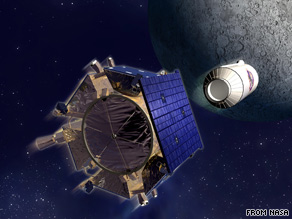
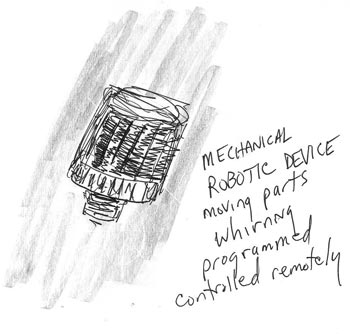
This session is filled with detail relating to the LCROSS mission. The viewer's accurate sketch of the LCROSS satellite is found on the last page of the session, and is reproduced below on this page. Elsewhere in the session, the viewer perceives many people watching an event in the sky (p. 15, pdf numbering). During this event, a great many people (on Earth) were watching the Moon, mostly with telescopes, looking for evidence of an expected plume caused by the impact of the Centaur upper-stage rocket and the LCROSS satellite. The sketch on page 13 (pdf numbering) may represent people on Earth watching the televised event, possibly on large monitors. Perceptions of the impact itself can be found on page 6 (pdf numbering) and elsewhere. The sketches on the first three pages of the session seem to be initial impressions of the Moon and the orbiting satellites. The sketch on page 12 (pdf numbering) may represent an antenna array. C3:UEP
Unexpected Perceptions: The viewer has a number of perceptions that seem unusual for this target. These perceptions include numerous sketches of tunnels, structures, and subjects (pages 5, 8, 11). Since these perceptions correspond with the perceptions of some other viewers, they are discussed separately below. |
| Debra |
Download |
Download |
In this session, the viewer clearly perceives a missile descending into a mountainous area. This is the primary gestalt for this target, and the clarity score is based on this accurate description in the session. C3:UEP
Unexpected Perceptions: While the primary gestalt of this session is that the viewer perceives a descending missile into mountainous terrain, the viewer also perceives structures, underground tunnels with vehicular traffic of some sort. The viewer also seems to have "humanized" the context of the structures and vehicular traffic, making these things appear normal for an Earth environment. Since these perceptions correspond with the perceptions of some other viewers, they are discussed separately below. |
| Maria |
Download |
Download |
This viewer clearly describes a flat land area surrounded by mountainous terrain, which is very appropriate for this target. See especially page 3 (pdf numbering). The viewer also perceives a large amount of falling particulate matter, which is appropriate for this target in which there was a plume of material resulting from the impacts of the "missiles" that included significant amounts of frozen water. The interpretation of a nearby body of water is not unusual given the smooth and curved topology of nearby land and crater basins. C3
Unexpected Perceptions: The viewer also perceives structures and subjects in this target. Since these perceptions correspond with the perceptions of some other viewers, they are discussed separately below. |
| Anne |
Download |
Download |
This viewer clearly perceives a mountainous terrain, "rough rocks" (p. 5, pdf numbering), something descending downward (see p. 7), and what appears to be a rising plume (also, p. 7, pdf numbering), all of which are very appropriate for this target. C3:UEP |
| Sita |
Download |
Download |
This viewer clearly perceives a spinning metallic object descending into a mountainous terrain (see the excellent sketch on p. 4, pdf numbering). On page 3, the viewer describes the "crash" into "wet rocks," all of which is appropriate for this target considering that the "missiles" crashed into ice. The crash undoubtedly melted much of the ice. C3:UEP |
| Michele (2 sessions) |
Download |
Download #1
Download #2 |
This viewer is new to remote viewing. The viewer does perceive mountains at the target, plus the idea of something "sinking." See especially Download #2. C1
Unexpected Perceptions: This viewer also perceives subjects and structures that appear to be underground in the mountainous terrain. Since these perceptions correspond with the perceptions of some other viewers, they are discussed separately below. |
All of the sessions in this experiment are truly excellent. In general, the viewers clearly perceive the mountainous environment of the target area, plus the descending NASA objects. Web site visitors should examine all of these sessions clearly. All of the data that can be verified are, in general, highly accurate with these sessions.
Regarding the "Unexpected Perceptions" mentioned in five of the session analyses above, these perceptions seem to suggest (i.e., not "prove") that there may have been some structures inside or near the Cabeus crater, perhaps underground. Unfortunately, the imagery supplied by NASA of this event is of extremely low resolution, and it is not possible to verify any of these data. Certainly much better images exist of this event, but NASA has not released such images for the public to see. The general rule with remote viewing is that ALL remote-viewing data must be considered speculative until they are verified using normal means of data gathering. It is not appropriate to disregard remote-viewing data just because they seem improbable. EVERYTHING needs to be verified, one way or another. Thus, IF structures do or did exist in or near the Cabeus crater, they would have to be of extraterrestrial (ET) origin. IF there are or were such structures, then these "unexpected" remote-viewing perceptions would be appropriate for this target. Remote viewing has uncovered equally surprising or unexpected things in the past that have turned out to be true after verification was achieved. Thus, there is no alternative to waiting for reliable verification, however long that takes. If these "unexpected perceptions" are incorrect, we will eventually find out. If they are correct, well, that would be cool.
As an aside, IF there is or was an ET base in or near the Cabeus crater, it would be a logical place for such a base. The base would be in permanent shadow, making it difficult or impossible to see from Earth. Moreover, since the crater is near the southern pole on the edge of the side of the Moon that permanently faces the Earth, ETs could come and go freely by approaching and departing the base from the far side of the Moon, which is not visible from the Earth. Thus, from that hidden location, the ETs could watch and monitor Earth and human activities without being seen. Again, this is only IF there is an ET base in that location. None of the remote-viewing data suggest a loss of life due to the LCROSS mission, which would also be appropriate IF there is or was an ET base in this location since the ETs would obviously see the LCROSS mission coming and evacuate the premises.
This, by the way, is a nice mystery. It is just the type of thing that future remote-viewing projects can investigate further. Since remote-viewing can clearly transcend time, this target can be revisited endlessly. Monitored remote-viewing sessions might be appropriate for further investigation, should anyone be interested in this. For example, below is a link to a monitored SRV session for the same target but which was not part of the Multiple Universes Project. Both the viewer and the monitor were blind to the target, and the target selection did not occur until well after the session was completed. The tasker did not see the session data until after the target was selected and the session was "closed" by the viewer. This viewer perceived an explosion in a mountainous area with structures and subjects nearby. Corresponding with the other sessions for this target, no subjects were hurt in the explosion. Again, this is speculative, but fun.
Notable Imagery:
| NASA Artist Sketch of LCROSS Satellite |
RV Sketch of LCROSS Satellite by Dick Allgire (HRVG) |
 |
 |
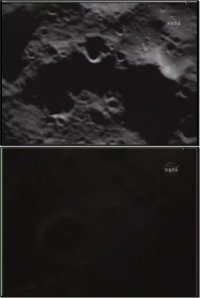
| Image of the Cabeus Crater on the Moon taken from the LCROSS satellite during its approach |
| Image of the interior of the Cabeus Crater showing impact area of Centaur upper-stage rocket that first impacted the crater |
|